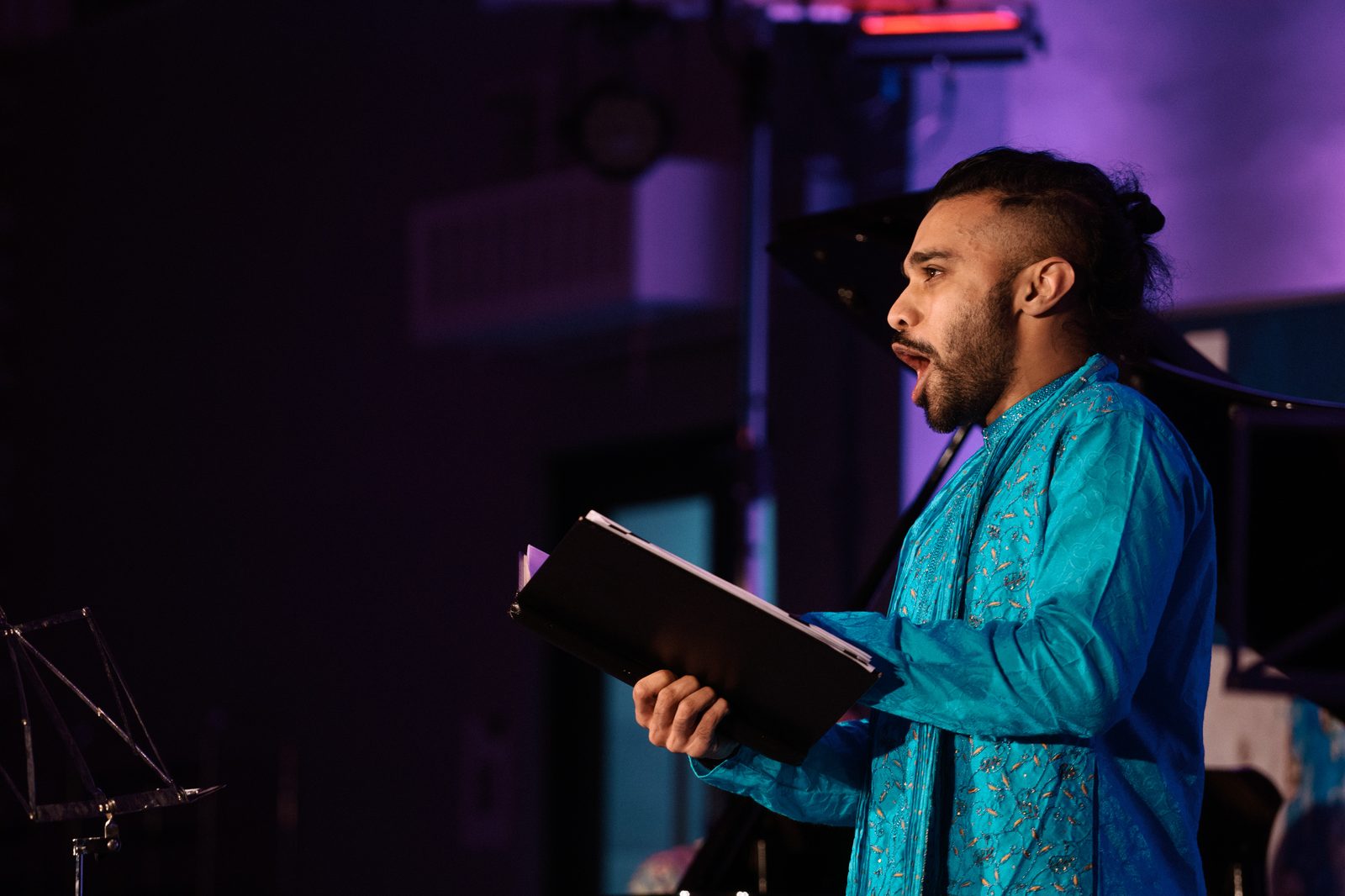
Opera singing is not natural. That's the premise I keep coming back to, and I think it's the honest one: like any serious athletic discipline, the voice has to be built, not discovered. You don't get a sustainable career by "letting go" and hoping the sound arrives — you get there by understanding, very precisely, what has to release and what has to hold. The conversation below is my attempt to work through that, part by part, starting from the base of the tongue and ending up, unexpectedly, in the middle of a dance floor.
Why does the base of the tongue matter so much for a baritone?
Because the tongue has almost no bony anchor of its own — the one place it attaches is the hyoid bone, which sits directly above the larynx. So when the root of the tongue pulls back and down, which is the single most common habit in untrained singers, it doesn't just affect articulation. It drags the whole larynx into a false, swallowed depth. That's the crucial distinction to make early: real vocal depth comes from a released, open pharynx, not from the tongue physically shoving the larynx downward.

So what's the actual exercise?
I use a thumb monitor. Make a thumbs-up and rest the pad of the thumb gently in the soft triangle behind the chin, between the two sides of the jawbone — that's the floor of the mouth, right above the digastric muscle. Then sing a slow five-note scale on "ah". If that tissue hardens or bulges into the thumb, either at the onset or as the pitch climbs, the root is gripping. The job is to keep it pliable, like uncooked dough, at mezzo forte or below while you're learning it. And released doesn't mean floppy — a passive tongue collapses backward and causes its own problems. The fix is forward activity: tip resting lightly against the lower front teeth, a slight groove down the middle.
You've talked about "locking the air" with the vocal cords. Where does that sit in established technique?
That's an old idea with an Italian name — lotta vocale, the "vocal struggle," a cousin of appoggio, where the breath is held in a kind of managed tension against the closed cords rather than released all at once. It's a real and useful principle. But it's worth separating cleanly from a different, less fashionable school: Melocchi's affondo, the deep-larynx technique behind Mario Del Monaco and, later, Franco Corelli. Affondo is about the larynx settling low through a released, expanded pharynx — not about muscling the tongue down to fake that depth. Same destination, completely different route, and confusing the two is exactly how singers injure themselves chasing a "big" sound.
Melocchi's low-larynx method reshaped Mario Del Monaco's voice in the 1930s and later influenced Franco Corelli, who studied it only loosely and deliberately modified it — he wanted the larynx to "float" rather than sit fixed at the bottom, to protect his mezza voce and legato. It's a useful reminder that even the singers most associated with a technique often adapted it rather than applying it wholesale. More on Arturo Melocchi →
How does the Metodo 3 Punti fit into all this?
M3p is the method I train in with Gianluca Terranova, and it's where a lot of this becomes practical rather than theoretical — diaphragmatic support, clean transitions between vowels, and systematically eliminating throat tension rather than just working around it. A good part of it is built from silent exercises, which matters enormously for a touring singer: you can run real technical work in an airport queue or a dressing room without making a sound.
You wanted to bring movement into this too, not just voice. Where do you start?
With Jerzy Grotowski, and specifically his idea of the via negativa — the negative way. His training wasn't about accumulating tricks; it was about eliminating whatever blocks a genuine impulse from becoming visible action. He built what he called a "score" of fixed physical actions, rehearsed as precisely as a piece of music, specifically so that once it was truly internalised, the conscious mind could stop interfering — the paradox being that a completely fixed score should still feel spontaneous, even involuntary, every time you perform it. That's not far from what happens in a role you've sung many times: the body has done it before, and at some point you stop watching yourself do it.
Grotowski called this eventual state "organicity" — the point where there's no longer a gap between impulse and action for a watcher to occupy. More on Towards a Poor Theatre →

And the connection to dance and partnering?
Two threads, both about groundedness. Tadashi Suzuki built an entire actor-training method around the feet — stomping, squatting, grounded walking — to develop what he called "animal energy," a rooted lower body that lets anything happening above the waist read as powerful rather than random, since it's connected to something stable underneath. The other thread is Steve Paxton's "small dance," from contact improvisation: the idea that even when you think you're standing perfectly still, your body is making constant tiny corrections just to hold balance against gravity. A trained mover keeps that small dance alive even inside big movement, so they're always ready to receive weight or a lead instantly. In partner dance, the equivalent is a principle tango dancers call disponibilidad — availability — where a follower's job isn't passivity, it's staying structurally ready so force passes through the joints cleanly instead of getting absorbed or blocked.
Suzuki developed his method with the Suzuki Company of Toga from the 1970s onward; it's now taught internationally, including at the Royal Shakespeare Company. Paxton originated contact improvisation in the early 1970s, growing out of his work with the Judson Dance Theater and the Grand Union. More on Tadashi Suzuki → · More on contact improvisation →
You've developed your own exercise around this — walk me through it.
I call it the office chair exercise. Picture an office chair: the base stays planted, and the top swivels freely above it. The base is the pelvis and hips — the rotation needs to come from the hip sockets, the femur turning inside the joint, almost like a door hinge at the hip crease, not from a twist through the lumbar spine. If someone can rotate their ribcage forty-five degrees with their feet glued down and barely feel anything move in the lower back, the hips are doing their job. The top of the chair is the ribcage and shoulders, which need to float on that swivel without bracing against it — because rib bracing restricts breath, and a restricted breath almost always shows up a beat later as a gripped throat. So a useful diagnostic is to hum or sustain a note while doing the swivel: the instant the pitch wobbles or the throat tightens is the exact instant the hip rotation broke down and got compensated for somewhere higher up.
Do you teach it by showing the correct version first, or the wrong one?
Wrong first, deliberately — it's sometimes called contrast training. The nervous system doesn't really learn "correct" from an abstract instruction like "keep your back still"; it learns correct by feeling the difference against something. So I'll have someone twist from the lumbar spine first, even exaggerate it, and let them feel that gripping quality travel up into the shoulders and throat. Then when they switch to hip-driven rotation, the release is obvious and immediate, rather than something they have to take on faith.
None of this is meant to sit as separate disciplines — voice over here, movement over there. The whole point of working through it this way is that they're the same problem asked twice: what has to release, and what has to stay quietly, reliably grounded underneath it. I'm building pieces this year that treat them as exactly that — probably as two distinct works rather than one, but built from the same underlying framework.
References
- Grotowski, Jerzy. Towards a Poor Theatre. 1968. grotowski.net
- Suzuki, Tadashi — Suzuki Method of Actor Training, Suzuki Company of Toga (SCOT). Wikipedia
- Paxton, Steve — originator of Contact Improvisation and the "small dance." Wikipedia
- Johnstone, Keith. Impro: Improvisation and the Theatre. Faber & Faber, 1979. Wikipedia
- Melocchi, Arturo — vocal pedagogy associated with Mario Del Monaco and Franco Corelli. Wikipedia
- Terranova, Gianluca — Metodo 3 Punti (M3p) vocal technique, as trained directly with the author.