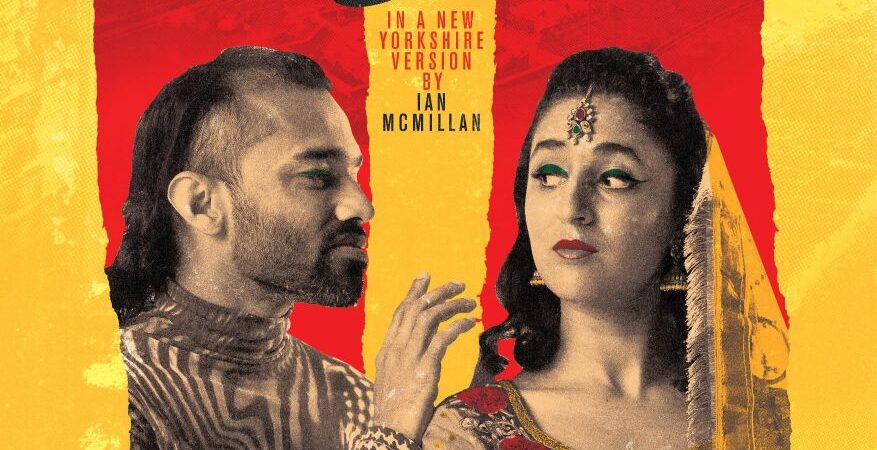
Bradford Opera Festival · Wilton's Music Hall · London
Oscar Castellino as Count Almaviva
Mozart's greatest comedy relocated to 1970s Bradford — where Yorkshire wit meets Indian classical music, and an aristocrat's arrogance meets its match.
Synopsis · Cast · Arias · Fun Facts · Wilton's History
The Production
Bradford Opera Festival brings Mozart's comic masterpiece crashing into a world of factory floors, curry houses, and a community in transformation. The aristocratic palace of Seville becomes the West Yorkshire of the 1970s — a landscape shaped by the wool trade, waves of immigration from South Asia, and a generation caught between old worlds and new.
The Count — once master of all he surveys — finds his authority crumbling not just because his valet is getting married, but because the world he ruled is changing around him. Director Alex Chisholm relocates the action without losing a note of Mozart's genius; instead, that genius gains new resonance in a Bradford that knew all too well about power, class, and who gets to call the shots.
The production weaves together two great musical traditions: Mozart's own Western classical score is reorchestrated by Ben Crick to incorporate instruments and idioms from Indian classical music, reflecting Bradford's multicultural heartbeat. The text — adapted with brilliant Yorkshire wit by poet Ian McMillan — includes passages in Urdu and Punjabi, translated by Kauser Mukhtar, honouring the communities that made Bradford what it is.
The result is an opera that feels at once timeless and urgently local — and a Count whose imperious certainties are tested at every turn by the baritone voice of Oscar Castellino.
The Story
Mozart himself called this "the most comical opera ever written." It unfolds across a single, increasingly chaotic day in which nearly everyone gets exactly what they deserve — and a few things they didn't expect. The original play by Beaumarchais was so politically explosive that Napoleon Bonaparte called it "the revolution already in action" — before a single guillotine had fallen. Small wonder the Emperor tried to ban it. (Source: The Guardian)
Figaro is measuring his and Susanna's room for their wedding — but Susanna has alarming news: the Count has been flirting with her and has positioned their room suspiciously close to his own quarters. The Count, it seems, would like to revive an ancient feudal right over his servants' brides. Figaro vows to outwit him. Meanwhile the teenage page Cherubino, hormones fully ablaze, is in love with every woman in the house — and the Count, catching him hiding with one woman too many, banishes him to the army. Figaro sends him off with a wry soldier's farewell.
The Countess weeps alone, neglected by her philandering husband. Susanna and Figaro hatch a plan: they will disguise Cherubino as Susanna to catch the Count in his own trap — and arrange for the Countess to catch him red-handed. The plan almost works — until the Count arrives at exactly the wrong moment and begins demanding what is behind the locked closet door. Cherubino leaps from the window. The Count, finding no Cherubino, is briefly embarrassed — but not converted. The battle has barely begun.
An extraordinary plot twist: old Marcellina has a claim on Figaro for an unpaid debt — a debt he can only discharge by marrying her. The case comes before the Count, who rules with alacrity: Figaro must marry Marcellina. But a birthmark on Figaro's arm reveals that he is Marcellina's long-lost illegitimate son — the case collapses in chaos. The wedding goes ahead; the Countess, alone for a moment, pours out her grief in the sublime aria "Dove sono". But her sadness hardens into resolve: she and Susanna will set a trap for the Count.
In the darkness of the garden, everyone is disguised as someone else. The Count makes ardent love to his own wife, whom he believes to be Susanna. Figaro, believing Susanna is flirting with the Count, nearly goes mad with jealousy — until the game is revealed. The Count is caught in his own trap, exposed before everyone. He drops to his knees and begs the Countess's forgiveness. She grants it. Mozart gives this moment — "Contessa perdono" — music of such beauty and unexpected gravity that it stops the comedy cold, turning what began as farce into something achingly close to grace.
At a Glance
Many scholars and opera-goers consider Le nozze di Figaro not merely the greatest of Mozart's operas but the greatest opera ever written. It is certainly the opera in which Mozart came closest to achieving music that illuminates human psychology with the depth of a novel. (Source: Encyclopædia Britannica)
Moments to Listen For
Figaro contains more famous music per act than almost any other opera. These are the moments that stop audiences in their tracks — many of them so embedded in culture that you may recognise them before you realise where they are from.
The opera's first great outburst of class rage. Figaro, alone onstage, turns to address the absent Count directly. "If you want to dance, my dear Count, I'll be the one calling the tune." The melody is a gavotte — a courtly dance — and Figaro uses the Count's own aristocratic forms against him. It is one of the sharpest, funniest, most politically charged moments in all of opera, and the music matches the insolence perfectly. (Source: Opera-Arias)
The Countess enters for the first time and the comedy stops. This brief, heartbroken aria — barely three minutes long — tells us everything about the Countess's pain, dignity, and loneliness. It is one of the most interior, psychologically rich pieces Mozart ever wrote. Not a note is wasted. (Source: Operabase)
Cherubino, the teenage page who is in love with love itself, sings a canzonetta about the bewildering, overwhelming experience of falling for everyone at once. Mozart wrote this in the style of a folk song, deliberately simple — but the music captures the helplessness of first love with a precision no amount of sophistication could achieve. It has become one of the most beloved songs in the entire operatic canon.
Oscar Castellino's great moment as the Count. After a legal setback, the Count erupts in one of the angriest, most musically magnificent baritone arias ever composed. "Shall a servant snatch the prize I've been denied? Shall I sigh while he is satisfied?" It is not a sympathetic portrait — but it is a devastatingly human one. The Count is ridiculous, petty, self-pitying, and powerful all at once, and Mozart's music makes you feel every contradiction.
The Countess alone, asking where those happy moments of love have gone. This aria, with its extraordinary rondo form — slow and melancholy at first, then rising into something like defiance — is considered by many the emotional peak of the entire opera. (Source: Encyclopædia Britannica)
The opera's most extraordinary moment. The Count, exposed and humiliated before everyone, kneels and asks his wife's forgiveness. Three simple words. And Mozart writes music of such quiet, unexpected beauty — a brief choral hymn rising suddenly out of the chaos of the finale — that every audience holds its breath. The comedy does not resume for several bars. It is, as one commentator wrote, "a moment of grace inserted into the middle of a farce — and it feels more true than anything around it." (Source: Lyric Opera of Chicago)
Fascinating Facts
The play on which Figaro is based — Beaumarchais's La folle journée, ou le Mariage de Figaro — was so politically inflammatory that Emperor Joseph II banned it from being performed in Vienna. The play depicted the aristocracy as corrupt, ridiculous, and morally unfit for the authority they wielded. Mozart and Da Ponte wrote their opera anyway — but cleverly toned down the most incendiary speeches to get it past the censors. The Emperor allowed the opera while the play remained forbidden. (Britannica)
Napoleon Bonaparte read the play five times before it was staged and called it "the revolution already put into action." He was not wrong: it opened in 1784, five years before the Bastille fell. The opera, premiered in 1786, was playing to packed Viennese houses as France moved toward catastrophe. (The Guardian)
On the night of the premiere — 1 May 1786 — the audience demanded so many encores that the performance lasted nearly twice as long as planned. Emperor Joseph II eventually had to issue an imperial decree banning encores from future performances, because the evening was simply going on too long. (Operabase)
Figaro is the first of the three Da Ponte operas Mozart wrote with librettist Lorenzo Da Ponte — the sequence that also includes Don Giovanni (1787) and Così fan tutte (1790). The three together form the most celebrated creative partnership in the history of opera. Da Ponte himself was a defrocked Venetian priest who had been expelled from Venice for adultery and ended up becoming Mozart's poet at the Viennese court. (Britannica)
Mozart composed the entire opera in six weeks — an extraordinary feat given its four acts, its large cast, and the psychological complexity of its ensembles. Several of the opera's finales are themselves ten to fifteen minutes of continuous, rapidly shifting musical argument. Many musicians consider the Act II finale — which runs for nearly thirty minutes without a break — the greatest single piece of dramatic musical writing ever composed. (Lyric Opera of Chicago)
Unlike Così fan tutte, which Beethoven and Wagner infamously despised, Le nozze di Figaro has attracted almost universal veneration. Beethoven is said to have declared it the greatest opera he knew. Wagner, despite his otherwise low opinion of opera before his own, is recorded admiring it. Even Brahms — notoriously austere in his enthusiasms — wept at the finale. (The Guardian)
The Cast
Oscar Castellino is an international baritone, ensemble singer at the Royal Opera House, and composer of the Mars Anthem Rise to Mars. Born in a car on a busy Mumbai street with roots tracing to Goa, his journey from software engineer to opera singer began when soprano Patricia Rozario discovered his voice. He trained at the Royal College of Music — one of only ten students selected from over 600 applicants for the Royal Opera Programme — graduating with First Class BA and MA degrees, and holds the Christopher Ball Welsh National Opera Scholarship.
His career spans WNO (solo debut as George Benton in Dead Man Walking), Barefoot Opera, Opera at Bearwood, and concert stages across the UK, India, and Europe. He is an ensemble singer at the Royal Opera House and sang for the late Queen's Diamond Jubilee on the River Thames in 2012. BBC News has called him "a rising star in the opera world."
Castellino is not new to Bradford Opera Festival: in the company's inaugural 2023 production of The Barber of Seville, he sang the title role — Figaro himself. Now he moves one rank up the social hierarchy to inhabit the Count: the man Figaro was outsmarting all along. It is a delicious inversion, and one that the Bradford audience will relish.
As Count Almaviva, Castellino inhabits a role written for the baritone at his most commanding and most conflicted: a man who insists on his power over others, who is fully aware of his own wrongdoing, and who — in the opera's final, extraordinary moment — must decide whether to ask forgiveness from the person he has wronged most.
A British Indian soprano from Liverpool, Natasha Agarwal first studied Mathematics at the University of Warwick before training at the Royal Academy of Music (MA in Vocal Performance, Distinction, studying with Nuccia Focile and Chad Vindin) and the National Opera Studio — the UK's leading postgraduate training ground for opera performers.
She has sung with Welsh National Opera, Opera Holland Park, Opera North, Waterperry Opera Festival, Glyndebourne, and the Royal Opera House Mumbai. She created the role of Zoe Green in Jonathan Dove's Uprising at Glyndebourne and the title role in Dove's Itch at Opera Holland Park. Awards include the Charles Wood International Song Prize and the Opera Holland Park Award for Outstanding Emerging Talent. She also co-curated the Diverse Voices National Talent Programme at the National Opera Studio — a programme to nurture singers from ethnically diverse backgrounds.
From New Delhi, Kanchana Jaishakar trained at the Royal Northern College of Music in Manchester on the Allan and Nesta Ferguson and Waverley Fund Trusts scholarships. She has participated in experimental opera projects including "Opera Rave" — a reimagining of Carmen with electronic music elements at the Leeds Opera Festival.
The Creative Team
About the Company
Founded by director Alex Chisholm and conductor-composer Ben Crick following their 2017 collaboration on Ice Cream: The Opera at the Bradford Festival, Bradford Opera Festival is dedicated to making opera that speaks from — and emerges from — Bradford's extraordinary cultural diversity. Their mission, stated simply: "Making opera in Bradford, for Bradford audiences in a very Bradford way."
The company's inaugural production was The Barber of Seville in 2023, with Ian McMillan's Yorkshire dialect adaptation at St George's Hall, Bradford — the first time the opera had been performed in broad Yorkshire. The Reviews Hub called it "cleverly and sympathetically done, with no mindless use of dialect stereotypes, but with plenty of vernacular to please the audience." Since then, Bradford Opera Festival has premiered The Last Machine Breaker (an opera about Luddites, AI, and revolution) and Nikkah (blending Punjabi folk music and Western classical tradition in English and Punjabi).
This production of The Marriage of Figaro is Bradford Opera Festival's first London outing — and what a stage to choose: Wilton's Music Hall, where Victorian East Enders once packed in to hear the same blend of popular culture and polished performance that Bradford Opera Festival now brings from the north. The company's work is rooted in the belief that opera, like Bradford itself, is not one thing. It is the product of migrations, encounters, and the creative friction between traditions — and is all the richer for it.
The Venue
Tucked down Graces Alley in the East End of London, Wilton's Music Hall is London's oldest surviving Victorian music hall — and one of the most atmospheric performance spaces anywhere in the world. It opened in 1859, built by John Wilton on the site of a row of five terraced houses knocked together. For several decades it was one of East London's most popular entertainment venues, hosting comedians, acrobats, and music-hall singers for dockside and immigrant communities.
After decades of neglect and threat of demolition, Wilton's was saved by a remarkable campaign in the 1960s that included Sir John Betjeman, Peter Sellers, and Spike Milligan, who petitioned for its preservation. It was listed as a Grade II* historic building. A major restoration between 2012 and 2015 preserved — and celebrated — its magnificent decayed splendour: peeling paintwork, exposed brickwork, and the golden glow of Victorian gas-lamp fittings are all part of its unique character.
Today Wilton's is an internationally acclaimed arts venue, described by The Guardian as "the most romantic room in London." Its intimate scale — around 300 seats — makes it perfect for opera: close enough to feel every breath, far enough to see the full stage picture. For a production set in Bradford's past, its Victorian walls carry exactly the right kind of history.
Address: Graces Alley, off Ensign Street, London E1 8JB
Nearest Tube: Tower Hill (District/Circle), Shadwell (DLR/Overground), or Aldgate East (District/Hammersmith & City)
Box Office: Available online at wiltons.org.uk
Three performances only · 23, 24 & 25 November 2026 · Wilton's Music Hall, London